
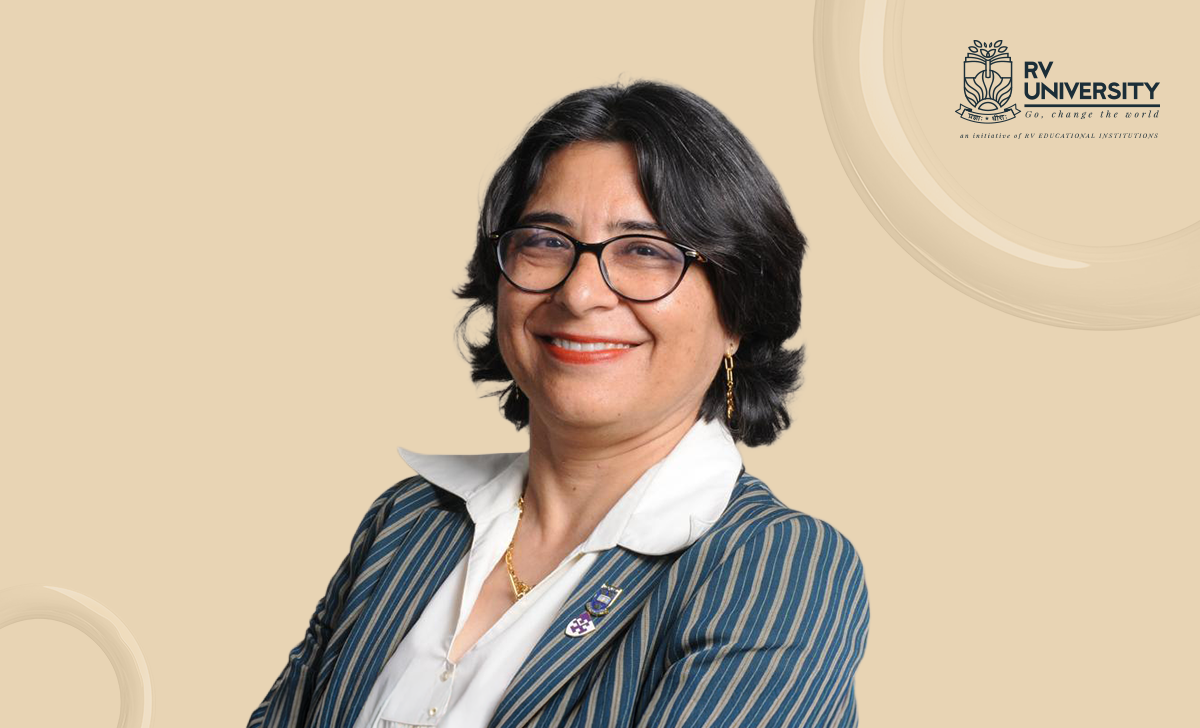
Suparna Kapoor
Professor of Practice

About
Suparna Kapoor is Professor of Practice in the School of Economics and Business at RV University. Her teaching, research, and practice are centred on a single question: How can work become a place where people grow not only in competence, but also in character, compassion, and wisdom.
With over three decades of professional experience spanning Engineering, Project Management, Human Resource, Learning & Development, Organizational Development, and Academia, she brings a practice-informed perspective to management education.
Prior to joining RV University, she led an independent L & D, Leadership and Coaching practice focused on building human capability through research-informed, experiential, and human-centred learning.
Earlier, she held senior leadership positions at Hindustan Aeronautics Limited (HAL), leading enterprise-wide initiatives in leadership development, organizational capability, and strategic HR. Across her career, she has designed and facilitated more than 400 leadership and management development programmes, impacting over 50,000 professionals across industry, government, and higher education.
Her scholarship and pedagogy integrate organizational behaviour, behavioural science, positive psychology, and applied theatre to create immersive learning experiences that foster self-awareness, collaboration, leadership, and organizational transformation. Her doctoral research at XLRI Jamshedpur explores emotions in organizational change, while her broader practice-based interests include leadership development, workplace wellbeing, and human capability.
A Chevening Fellow from the University of Oxford, Suparna has completed executive and leadership development programmes at XLRI, IIM Ahmedabad, IIM Lucknow, IIM Kozhikode, IAS Toulouse (France), and the South East Asia Leadership Academy (SEALA). She also holds a specialization in Positive Psychology from the University of Pennsylvania (USA) and has received professional training in applied theatre, storytelling, neuro-linguistic programming (NLP), and creative movement.
These diverse experiences continue to shape her interdisciplinary approach to leadership development, management education as a means of developing not only better professionals, but better human beings.
Organizational Behaviour and Leadership – Research at the intersection of organizational behaviour, leadership development, and experiential management education, addressing contemporary organizational challenges.
Emotions and Organizational Change – Examining how emotions, learning, and human relationships influence organizational change, leadership effectiveness, and organizational resilience.
Applied Theatre and Experiential Learning – Investigating the use of applied theatre and other experiential pedagogies to enhance leadership, communication, team building and socio-emotional capability.
Research-Informed Management Practice – Translating scholarly research into evidence-based approaches for executive education, organizational development, and capability building that create more human-centred organizations.
Research Interests
Emotions and Organizational Change – examining how emotions shape organizational change across individual, team, and organizational levels, and their implications for leadership, adaptation, and organizational effectiveness.
Applied Theatre in Management Education – exploring the integration of applied theatre methodologies, including Forum and Improvisational Theatre, into management education to enhance reflection, collaboration, leadership, and socio-emotional learning.
Leadership and Followership – investigating leadership development through the complementary lens of followership, with a focus on translating research into effective leadership and followership practices in organizations.
Practice based research areas include:
Human Flourishing – developing evidence-based approaches to fostering inclusive leadership, workplace wellbeing, resilience, and human flourishing across diverse organizational contexts.
Behavioural Decision-Making – understanding how cognitive, emotional, and contextual factors influence managerial judgement and decision-making under conditions of complexity and uncertainty.
Corporate Leadership Excellence Award in Learning & Development (2025) – DigiOne
India’s 50 Most Admired Women Leaders (2024) – SheInspire Magazine
Women Achievers Award – Women in Public Sector (2020)
Certificate of Appreciation, 8th Asian Women in Leadership Summit (2019)
Winner of AIMA National Award for Managers (2018)
“Distinguished Jury Council Member” of the National Forum for Learning, Innovation & Growth (NFLIG), India.
Joint Secretary, Combined Social Ventures, Oxford, UK

 Academics
 Admissions
 Faculty
 Enquire